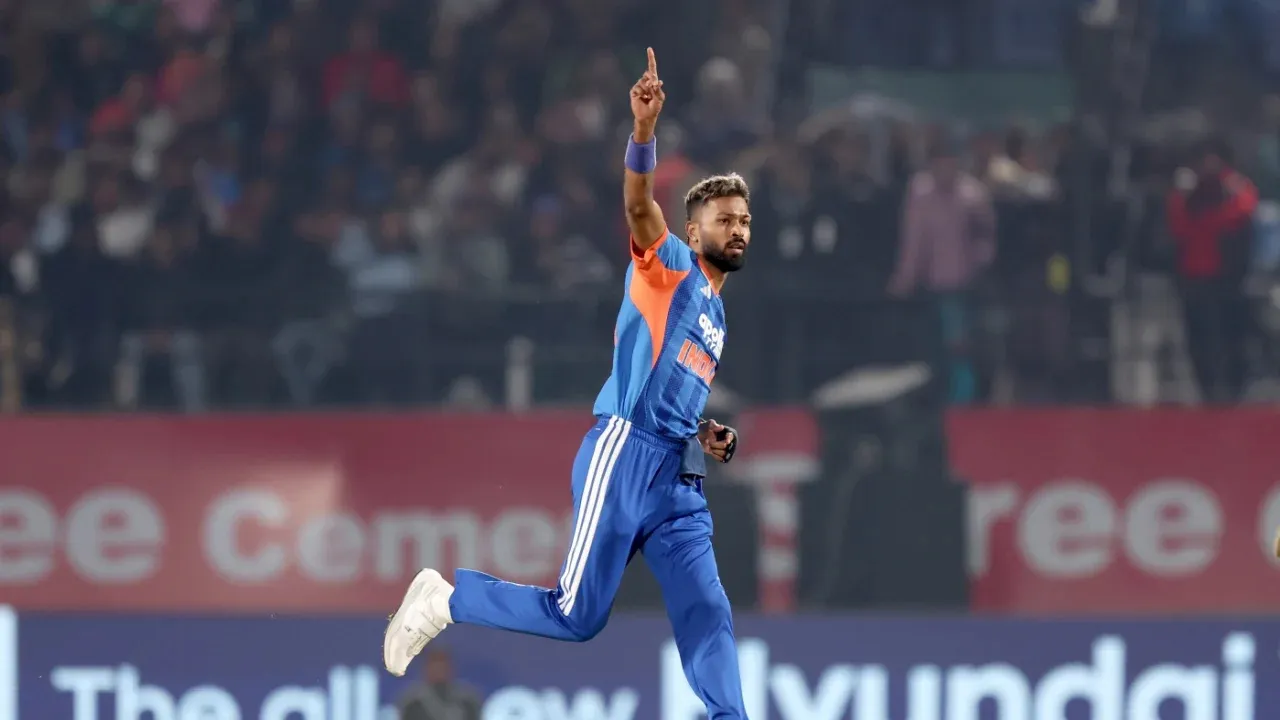
Hardik Pandya continues to prove why he’s India’s MVP, joins Arshdeep Singh and Jasprit Bumrah in elite bowling list
Hardik Pandya has quietly — then emphatically — written another chapter in his India story. The all-rounder reached a landmark in India’s recent T20 series, joining Jasprit Bumrah and Arshdeep Singh as one of the few Indian pacers to cross the 100-wicket mark in T20 internationals. That milestone is a reminder: Hardik is not just a big-game batter or a handy bowler — he’s India’s MVP in white-ball cricket when balance and match-winning impact matter.
Why the milestone matters: Hardik Pandya’s growth as a genuine all-round match-winner
Hardik Pandya’s journey has often been framed around power hitting and finishing games. But his recent performances show a far broader value: genuine bowling threat, tactical acumen, and the ability to change match momentum with both bat and ball.
Crossing 100 T20I wickets places him in elite company for India. This is not simply a counting stat — it reflects sustained contribution in different conditions, at different stages of matches, and often in high-pressure roles. Unlike specialist bowlers, Hardik’s workload is split between batting, bowling, fielding and leadership responsibilities, which makes the achievement especially noteworthy.
The stat that grabbed headlines: the double of 1,000 runs and 100 wickets
In the third T20I against South Africa at Dharamsala, Hardik dismissed Tristan Stubbs to complete a unique double: 100 T20I wickets alongside over 1,000 T20I runs — a feat no other pace-bowling all-rounder from India has achieved. That combination (1,000+ runs and 100+ wickets in T20Is) underlines his rare dual threat and adds a historical sheen to the milestone.
Match context: how Hardik stamped his authority in the series
India’s recent T20 fixtures against South Africa saw convincing collective performances, with Hardik contributing impactfully in both departments.
He delivered tidy overs when the team needed to arrest runs, and in earlier matches produced an all-round show — a quickfire 59* and a useful bowling spell — that swung the series. Those performances helped India record a dominant win (and at times dismantle a strong batting lineup), amplifying Hardik’s role as a reliable game finisher and emerging strike bowler in T20Is.
Short ball, variations and death overs: what’s changed in Hardik’s bowling
Hardik’s bowling evolution is visible in three areas:
- He has developed better control over slower bouncers and cutters, making him harder to time.
- He uses variations (back-of-the-hand slower deliveries, cutters, and subtle changes of length) more intelligently in short spells.
- He’s frequently used in high-leverage phases — powerplay and death overs — signaling captain and coach trust.
These adjustments have increased his wicket-taking ability and lowered his economy in crucial junctures, turning him into a bona fide strike option rather than an occasional partnership breaker. Observers and analysts have pointed to this tactical maturity as a key factor in his recent success.
Comparison: Hardik Pandya, Arshdeep Singh and Jasprit Bumrah — different strengths, same elite status
Hardik joins Arshdeep and Bumrah on the “100-wickets” list, but the three players represent different bowling archetypes for India.
- Jasprit Bumrah is the benchmark: a world-class, repeatable death-over specialist with uncanny yorkers and seam control. His wicket tally reflects longevity and sustained excellence.
- Arshdeep Singh has built his reputation on swing and disciplined powerplay bowling, regularly making early inroads. His 100+ T20I wickets came from consistent use in attacking roles.
- Hardik Pandya blends pace, variation and all-round value. Unlike the other two, he’s a frontline batter who also bowls meaningful overs — his 100 wickets therefore represent a dual contribution that few others in India can match.
That trio’s presence in the same list tells a bigger story: India now has diverse and deep pace options in T20 cricket, enabling flexible tactics and stronger bench strength.
What this means for India’s T20 plans and World Cup readiness
Hardik’s consistency gives India options. With Hardik bowling quality overs and contributing big runs, selectors and captains can:
- Play an extra specialist batter where conditions demand, knowing Hardik can provide 3–4 overs.
- Rotate Bumrah and Arshdeep optimally across powerplays and death overs, with Hardik covering middle phases.
- Use Hardik as a match-up tool against specific opposition batters, combining his bowling with batting firepower.
In tournament cricket — where net run rate, squad balance and bench depth matter — having a proven all-rounder who can deliver high-impact bowling spells is a strategic advantage.
A look ahead: how Hardik can build on the milestone
Milestones are great, but continued relevance depends on adaptation. For Hardik to stay India’s MVP, he should focus on:
- Fine-tuning death-over execution, especially yorker accuracy and slower-ball deception.
- Managing workload carefully to remain available across formats.
- Leveraging experience to mentor younger pace resources, boosting team balance in the long run.
If he does that, Hardik’s role will only deepen — not just as a player who occasionally finishes games, but as a multi-dimensional leader on the field.
Final word: Hardik Pandya — more than a highlight reel
Hardik Pandya’s 100th T20I wicket is not only a number. It’s confirmation that an explosive batter can mature into a match-defining bowling option without losing batting potency.
He’s proven time and again that he can change games with the bat, the ball, and with his presence. Joining Arshdeep Singh and Jasprit Bumrah in the elite bowling list is recognition of that growth. For India, that’s a luxury: a player who can tilt matches in multiple ways. For Hardik, it’s another milestone — and a platform to become even more indispensable.
Also Read: Dhurandhar Day 10: Ranveer’s Biggest Day Incoming! – Logic Matters